


Nigerian Army Drone Attack 2026
Terror from the Sky: ISWAP Drone Attack Hits Nigerian Army Base in Borno, 11 Killed
Nigerian Army drone attack 2026 survivors describe a terrifying escalation in insurgent tactics as ISWAP militants used weaponized drones to breach the Sabon Gari base in Borno.Death from Above: The Day Armed Drones Redefined the War in Borno
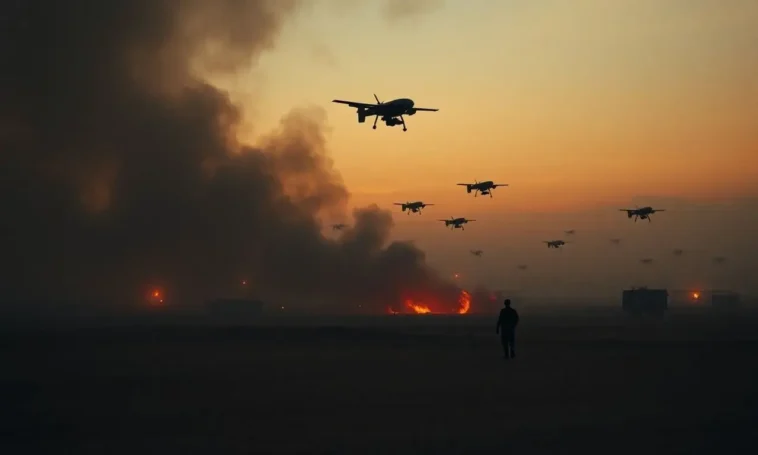
The dawn of January 29, 2026, did not bring the usual desert calm to Sabon Gari, Borno State. Instead, it brought a high-pitched, mechanical whine that has become the new soundtrack of terror in Northeast Nigeria. In a chilling escalation of the 17-year insurgency, Islamist militants from the Islamic State West Africa Province (ISWAP) launched a sophisticated, drone-backed assault on a Nigerian Army base, leaving a trail of destruction and 11 brave defenders dead. This wasn’t a standard hit-and-run; it was a calculated, multi-domain strike that signals a frightening evolution in militant capabilities.
Table of Contents
- Nigerian Army Drone Attack 2026
- Terror from the Sky: ISWAP Drone Attack Hits Nigerian Army Base in Borno, 11 Killed
- Death from Above: The Day Armed Drones Redefined the War in Borno
- The ISWAP “Techno-Caliphate”: How Drones Changed the Game
- Estimated Drone Deployment Trends: 2023–2026
- Sacrifice in the Trenches: Honoring the Fallen Heroes
- The Vulnerability of the “Supercamp” Strategy
- Electronic Warfare: The Race for Counter-Drone Supremacy
- The Global Connection: Where Do the Drones Come From?
- Operation Hadin Kai: A Pivot to the Skies
- Winning the Hearts, Minds, and the Signal
- Shop Products On Amazon
- Shop Products on Ebay
- Trending Similar Stories in the News
- Trending Videos of Nigerian Army Drone Attack 2026
- Similar Popular Articles
Eyewitness accounts and military sources describe a scene of chaotic, modern warfare. Before the first ground troops emerged from the treeline, small, weaponized quadcopters were already hovering over the base’s perimeter, dropping improvised explosive devices (IEDs) with surgical precision. The garrison, caught in the crosshairs of a “techno-caliphate,” fought valiantly as militants breached the facility, destroying vital military hardware, including an excavator and a low-bed trailer. By the time reinforcements arrived to repel the invaders, the message was clear: the sky is no longer safe.
The human cost of this digital-age ambush is staggering. Nine soldiers and two members of the Civilian Joint Task Force (CJTF) made the ultimate sacrifice, while 16 others were rushed to medical facilities with life-altering injuries. This incident marks the second time in a single week that drones have been used to hammer military formations in the region, proving that the Oct 2025 “test runs” have now evolved into a standard operating procedure for the insurgents.
The ISWAP “Techno-Caliphate”: How Drones Changed the Game
For years, the Nigerian military held an undisputed monopoly on airpower. That era ended in the smoke of Sabon Gari. ISWAP has successfully transitioned from using drones purely for propaganda and surveillance to deploying them as “poor man’s airforce.” By modifying commercial, off-the-shelf drones, they have achieved a level of tactical specialization that was previously reserved for state actors. These devices allow militants to scout troop movements in real-time, find gaps in “Supercamp” perimeters, and execute kinetic strikes without risking a single fighter.
The sophistication of these attacks suggests more than just local ingenuity. Intelligence reports indicate an influx of foreign tactical instructors and a robust supply chain funneling advanced UAV components through the porous borders of the Lake Chad Basin. This is no longer a ragtag group of forest fighters; it is an agile, tech-enabled insurgency that utilizes the same asymmetric tactics seen in global flashpoints like Ukraine and the Middle East. The psychological impact on troops is immense, as the threat now comes from an angle they were never trained to defend: directly above.
Estimated Drone Deployment Trends: 2023–2026
| Year | Primary Drone Usage | Estimated Success Rate | Reported Incidents |
|---|---|---|---|
| 2023 | Surveillance & Propaganda | Low (Detection frequent) | 12 |
| 2024 | IED Delivery (Experimental) | Moderate | 28 |
| 2025 | Coordinated Swarm Attacks | High | 45 |
| 2026 (Jan) | Kinetic Strikes & Base Breaches | Very High | 8+ (to date) |
Sacrifice in the Trenches: Honoring the Fallen Heroes
Behind the headlines of technology and tactics are the stories of men like those who stood their ground at Sabon Gari. The 11 defenders who “paid the ultimate price” were the backbone of the local security architecture. The CJTF members, often local hunters and volunteers, have become indispensable allies to the regular army, yet they face these high-tech threats with often basic equipment. Their loss ripples through the communities they protected, sparking a mix of grief and renewed resolve among the local population.
As the Nigerian Army’s 22 Armoured Brigade and other units continue to pound bandit enclaves in Kwara and Borno, the memory of the fallen serves as a grim reminder of the stakes. The military has vowed to “neutralize” those responsible, but the grieving families of the nine soldiers remind us that every tactical “shift” in warfare is written in the blood of patriots. These men weren’t just names on a casualty list; they were the frontline of a nation’s survival against a digital-age terror.
The Vulnerability of the “Supercamp” Strategy
The Sabon Gari attack has reignited a fierce debate within the Nigerian Defense Headquarters (DHQ) regarding the “Supercamp” strategy. Designed to concentrate troops into large, fortified bases to prevent them from being overrun, the strategy was meant to provide a secure launchpad for offensives. However, the rise of drone warfare has turned these static camps into “sitting ducks.” A drone doesn’t care about a trench or a sandbag wall; it flies over them.
Critics argue that while Supercamps protect against traditional ground assaults, they create a target-rich environment for aerial IEDs. Militants can now hover outside the base’s visual range, map out the exact location of fuel depots, ammunition dumps, and command centers, and then strike with devastating accuracy. The “isolation” of these bases, often separated by difficult terrain and “porous” borders, makes rapid reinforcement difficult when the sky starts falling.
Aerial View of a Typical 'Supercamp' Breach Pattern

[ Sky / Drone POV ]
|  . (Drone 1 - Surveillance)
|          . (Drone 2 - Strike)
V          V
+-----------------------+
|   Ammunition Dump     | <--- Primary Target
| [X] Explosive Impact  |
+-----------------------+
|    Command Center     | <--- Secondary Target
+-----------------------+
| Ground Breach Point   | <--- Militants enter during confusion
+-------/   \-----------+
Electronic Warfare: The Race for Counter-Drone Supremacy
Recognizing the existential threat, the Nigerian military is scrambling to modernize. Major General Michael Onoja of the DHQ recently disclosed that investigations into the sources of these drones have reached an "advanced stage." But tracing the source is only half the battle; stopping them in mid-air is the immediate priority. Nigeria has already begun deploying the Lithuanian-made EDM4S SkyWiper, a handheld jamming device that disrupts a drone’s GPS and control signals.
However, the Sabon Gari incident suggests that jammers alone aren't enough. Experts are calling for a multi-layered defense system that includes:
- AESA Radar Systems: To detect small, low-flying objects that traditional radar misses.
- Automated Turrets: Capable of "hard-kill" interceptions of incoming UAVs.
- Electronic Domination: Wide-area signal blocking around critical bases.
The Global Connection: Where Do the Drones Come From?
One of the most disturbing aspects of the Borno attacks is the "globalization" of the conflict. Analysis of recovered debris from various sites shows a mix of components: DJI rotors from the commercial market, 3D-printed explosive triggers, and high-gain antennas that extend the drones' range significantly. This points to a sophisticated logistical network that spans from the markets of the Middle East to the smuggling routes of the Sahel.
The influx of foreign fighters, primarily from Arab nations, has brought more than just manpower; it has brought the "know-how" of modern asymmetric warfare. These instructors are training a new generation of ISWAP fighters who are more comfortable with a tablet controller than an AK-47. This "technological spillover" from other conflict zones into Nigeria suggests that the Lake Chad Basin has become a testing ground for the future of global terrorism.
Operation Hadin Kai: A Pivot to the Skies
In the wake of the casualties, Operation Hadin Kai is undergoing a radical shift. The Nigerian Air Force (NAF) has ramped up its own drone operations, utilizing the recently acquired Bayraktar TB2s from Turkey to conduct 24/7 surveillance over suspected launch sites. In late 2025, a joint Nigeria-US operation in Sokoto used precision drone strikes to dismantle an ISIS-linked hub, proving that when the state uses technology effectively, it can be a decider.
The military's renewed offensive isn't just about bullets anymore; it’s about "intelligence fusion." By integrating real-time satellite data with ground intelligence and aerial surveillance, the Army aims to "starve" the terrorists of their electronic gadgets. Recovering a surveillance drone and arresting an ISWAP logistics supplier in a recent Borno raid was a small but significant victory in this silent war of signals.
Winning the Hearts, Minds, and the Signal
As we look toward the remainder of 2026, the battle for Borno will be won as much in the electromagnetic spectrum as on the ground. The "shock factor" of seeing drones used as weapons has rattled civilian confidence, and restoring that sense of security is paramount. The Nigerian military must not only defeat the drones but also the narrative of "invincibility" that ISWAP tries to project through their aerial propaganda.
The road ahead is fraught with challenges—terrain, resource demands, and a rapidly evolving enemy. But as Nigeria climbs the global military hierarchy, ranking 33rd in the 2026 Global Firepower Index, the focus must remain on innovation. We invite you, our readers, to join the conversation: How can Nigeria better protect its frontline heroes from this new "terror from the sky"? Is it time for a dedicated "Drone Command" within the Armed Forces?
Reported by Aiden Hughes (@AidenReports) for NewsBurrow Nigeria.
The chilling events at Sabon Gari have underscored a brutal reality of modern conflict: the traditional perimeter is no longer enough to guarantee safety. As insurgents increasingly turn to readily available commercial technology to launch lethal aerial strikes, the need for proactive defense has moved from the strategic halls of military headquarters to the immediate concerns of frontline personnel and security-conscious organizations. The psychological weight of an invisible, overhead threat is immense, but the rapid evolution of "soft-kill" countermeasures is providing a critical lifeline for those operating in high-risk zones.
In this digital-age arms race, having the ability to "blind" a hostile drone before it reaches its target is the difference between life and death. Modern electronic warfare tools, once reserved for elite signals units, are becoming more accessible and intuitive, allowing users to disrupt control frequencies and GPS signals with surgical precision. For security professionals, estate managers, and tactical teams, integrating these specialized detection and neutralization tools into their daily safety protocols is no longer optional—it is a fundamental requirement for maintaining a secure environment in 2026.
Staying ahead of these evolving aerial threats requires access to the same high-tier technology being deployed in global conflict zones. We have curated a selection of industry-leading defense solutions designed to detect, track, and neutralize unauthorized UAVs effectively and legally. We invite you to explore these essential security assets to ensure your perimeter remains impenetrable from all angles. Do you believe private organizations should have more autonomy in deploying counter-drone tech? Share your thoughts in the comments below and subscribe to our Naija NewsBurrow newsletter for the latest breakthroughs in national security and innovation.
Shop Products On Amazon
Shop Products on Ebay
Trending Similar Stories in the News
Drone-backed militants attack Nigerian army base, several soldiers dead Reuters...
Trending Videos of Nigerian Army Drone Attack 2026
Troops Repel ISWAP Drone Attack, Neutralise Over 18 Terrorists
Similar Popular Articles
#NigerianArmy #BornoState #SecurityWatch #DroneWarfare #BreakingNewsNigeria
Nigerian Army News, Borno Terror Attack, ISWAP Drone Tactics, Nigeria Security Updates, Operation Hadin Kai
