


Makoko Lagos Demolition 2026
Makoko Demolition 2026: 40,000 Displaced as Lagos Budget of Prosperity Faces Humanitarian Crisis
Makoko Lagos Demolition 2026 has left an estimated 40,000 residents homeless, sparking an international humanitarian outcry that contrasts sharply with the state’s ambitious ‘Shared Prosperity’ agenda.By Fatima Al-Hassan (@FatiAlHassan)
Table of Contents
- Makoko Lagos Demolition 2026
- Makoko Demolition 2026: 40,000 Displaced as Lagos Budget of Prosperity Faces Humanitarian Crisis
- The Venice of Africa Under Siege: A Dawn of Despair in Makoko
- By the Numbers: The Staggering Scale of the 2026 Displacement
- The ‘Budget of Shared Prosperity’ vs. The Reality on the Water
- Lives on the Edge: The Human Cost of ‘Urban Renewal’
- High-Tension Tensions: Decoding the Government’s Safety Justification
- The Global Alarm: UNICEF and IOM’s Emergency Intervention
- The Gentrification Ghost: Is Real Estate Driving the Bulldozers?
- Beyond the Rubble: Seeking a Sustainable Megacity Blueprint
- Shop Products On Amazon
- Shop Products on Ebay
- Trending Similar Stories in the News
- Trending Videos of Makoko Lagos Demolition 2026
- Similar Popular Articles
The Venice of Africa Under Siege: A Dawn of Despair in Makoko
The metallic hum began under the cover of darkness on December 21, 2025. For the residents of Makoko, the “Venice of Africa,” the low-frequency vibration felt like a distant generator or the familiar rumbling of trucks across the Third Mainland Bridge. But as the sun began to peek over the Lagos Lagoon, the silhouettes of amphibious excavators—cold, steel giants escorted by armed police—sharpened into a terrifying reality. Without the courtesy of a final whistle, the machines roared into life, tearing through a century of history in a matter of hours.
For generations, this floating settlement has defined the resilient spirit of Lagos, a labyrinth of wooden shacks on stilts where life is dictated by the ebb and flow of the tide. By midday, that rhythm was shattered. Cries of “Olorun o!” (Oh God!) pierced the air as the first homes collapsed into the black water. The Makoko Lagos Demolition 2026 was no longer a threat whispered in government corridors; it was a brutal, physical erasure of a people whose only crime was living where the city’s elite now want to play.
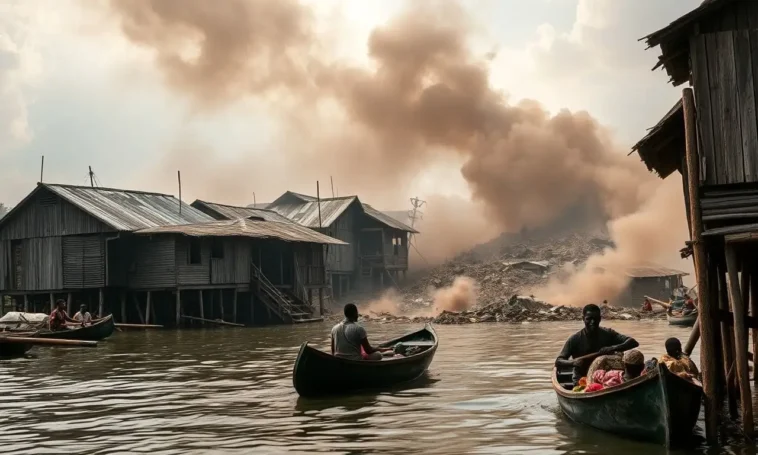
The scene was nothing short of a war zone. Smoke from tear gas canisters mixed with the morning mist, and the sound of splintering timber replaced the usual morning chatter of fishermen. This wasn’t just a demolition; it was a siege on the soul of the lagoon. Families who had lived here for over 40 years watched their entire lives—beds, bibles, and fishing nets—sink into the abyss. The historic settlement, once a vibrant hub of culture and commerce, was being systematically dismantled under the watchful eye of the law.
By the Numbers: The Staggering Scale of the 2026 Displacement
Statistics often fail to capture the weight of a tear, yet the data surrounding this event is harrowing. According to a rapid needs assessment report dated January 26, 2026, the scale of the displacement has reached a boiling point. The numbers paint a grim picture of a city moving forward by stepping over its most vulnerable. Over 3,000 structures, including homes, schools, and churches, have been flattened, turning a thriving community into a graveyard of floating debris.
Estimates from NGOs and humanitarian agencies like the IOM and UNICEF suggest that the number of displaced persons has surged to 40,000. Perhaps the most heartbreaking statistic is that a majority of those displaced are children under the age of 18. These are children who, just weeks ago, paddled to school in wooden canoes, but are now huddled together in those same canoes, which serve as their only remaining shelter against the elements.
| Metric | Reported Figures | Source/Agency |
|---|---|---|
| Total Displaced Persons | 40,000 | ECHO / UNICEF / IOM |
| Structures Razed | 3,000+ | Local Rights Groups |
| Reported Fatalities | 5 (including 2 infants) | The Guardian / Residents |
| Age Demographic Hit | >50% Children under 18 | Needs Assessment Jan 26 |
The ‘Budget of Shared Prosperity’ vs. The Reality on the Water
The timing of this humanitarian crisis creates a jarring irony that is impossible to ignore. Just as the bulldozers were finishing their work in Makoko, Governor Babajide Sanwo-Olu was signing the ₦4.4 trillion 2026 Appropriation Bill into law. Tagged the “Budget of Shared Prosperity,” the fiscal document is designed to transform Lagos into a “resilient megacity.” However, for the residents of the lagoon, that prosperity feels decidedly exclusive. While 52% of the budget is earmarked for capital expenditure, there is a glaring absence of a resettlement plan for the 40,000 people now adrift.
This “shared prosperity” seems to halt at the water’s edge. While the government celebrates a $1 trillion economy goal, the people of Makoko are forced into deeper poverty. The disconnect between the high-flying economic rhetoric and the damp, cold reality of a displaced fisherman is vast. Critics argue that a budget of such magnitude should have a clear, compassionate provision for those displaced by urban renewal projects, rather than leaving them to the mercy of the elements.
The fiscal strategy prioritizes infrastructure that beautifies the city and attracts foreign investment, but it often does so at the cost of the “invisible” citizens. For the fish smokers and canoe carvers of Makoko, the budget is not a promise of growth, but a death warrant for their traditional way of life. The question remains: in a city with a ₦4.4 trillion budget, why is there no room for the poor?
 Lagos Budget Distribution 2026 (Simplified ASCII Graph)Capital Expenditure   [####################] 52%
Recurrent Expenditure [#################   ] 48%
Makoko Resettlement   [                    ] 0% (Allocated specifically)
Lives on the Edge: The Human Cost of ‘Urban Renewal’
Beyond the spreadsheets and legislative signatures are the humans whose lives have been paused. Take Taiwo Ojokuno, who welcomed her newborn baby into a home that was demolished just hours later. “Nobody issued a warning,” she sobbed while speaking to reporters. “They just came and pulled down our houses. It is really painful.” For Taiwo and thousands like her, the “urban renewal” is not a concept; it is the loss of her bed, her kitchen, and her safety.
The tragedy is compounded by reports of at least five fatalities. Residents and rights groups allege that two infants died due to complications from tear gas inhaled during the police enforcement. Three other adults reportedly perished inside the boats they had taken refuge in, succumbing to the harsh conditions and the shock of losing everything. These aren’t just numbers; they were members of a community that has survived on this lagoon for over a century.
Currently, the lagoon is dotted with makeshift tents erected on the stumps of what used to be houses. Families are sleeping sitting upright in narrow canoes to avoid falling into the water, huddling together for warmth as the night breeze sweeps across the lagoon. The sense of grief is thick enough to touch. “Everything has been taken away,” says Timothy Ategi, a fisherman who lost both his home and his nets. “When your house is pulled down into the water, it disappears quickly. You cannot pick your life back up.”
High-Tension Tensions: Decoding the Government’s Safety Justification
The Lagos State Government, through Commissioner for Information Gbenga Omotoso, has been firm in its defense. The primary justification? Safety. Officials argue that structures built within 100 meters of the high-tension power lines that crisscross the lagoon are “walking disasters.” The government claims that a single cable snapping and falling into the water would lead to a catastrophic loss of life through electrocution. No responsible government can allow people to live directly under high-tension cables,” Omotoso stated during a recent media session.
However, the residents of Makoko have a different story. While they acknowledge the risk of the power lines, they allege that the bulldozers moved far beyond the agreed-upon 30-meter buffer zone, clearing swathes of land that were never mentioned in prior safety discussions. There is a growing suspicion that the “safety” narrative is a convenient pretext for clearing the waterfront for more lucrative developments. If safety was truly the concern, residents ask, why were they not provided with alternative housing before being pushed into the lagoon?
The clash of narratives highlights the deep distrust between the state and its informal settlements. While the state speaks of “resilience” and “megacity status,” the people of Makoko speak of survival and heritage. The government’s e-GIS mapping may show “illegal structures,” but the people see a century of ancestry. This “high-tension” standoff is about more than just electricity; it’s about who has a right to the city’s soil—and its water.
The Global Alarm: UNICEF and IOM’s Emergency Intervention
The scale of the Makoko Lagos Demolition 2026 has caught the eyes of the international community. On January 28, 2026, the UN agencies UNICEF and IOM released a “Flash Report” flagging a humanitarian crisis. The report identified an immediate and desperate need for food, clean water, and sanitation services. With the destruction of latrines and the pollution of the water by debris, the risk of a cholera outbreak is now a looming shadow over the displaced population.
International observers are particularly concerned about the “protection crisis” involving the thousands of children now living in open-air conditions. These agencies are calling for an immediate cessation of hostilities and a structured resettlement plan. The involvement of global bodies adds a layer of scrutiny that the Lagos State Government cannot easily ignore, turning what they termed an “urban renewal exercise” into a matter of international human rights law.
Priority needs as identified by the 2026 Needs Assessment:
- Emergency Shelter: Tens of thousands are sleeping in open canoes or makeshift tents.
- WASH Services: Lack of clean drinking water and functional toilets is critical.
- Food Security: Livelihoods (fishing and fish smoking) have been completely destroyed.
- Education: Schools have been razed, leaving children without access to learning.
The Gentrification Ghost: Is Real Estate Driving the Bulldozers?
There is a “shock factor” that keeps the residents of Makoko awake at night, and it isn’t just the fear of the next bulldozer. It is the sight of sand-filling and land reclamation projects happening just a stone’s throw away from the demolished ruins. For many, this is the ultimate betrayal. The suspicion is that Makoko is being cleared not for safety, but to make way for the next “Eko Atlantic” or high-end waterfront apartments for the billionaire class.
History supports this fear. From the destruction of Maroko in the 1990s to the more recent razing of Otodo-Gbame, waterfront communities in Lagos have consistently been cleared to create space for luxury real estate. Critics point out that while the government calls the stilt houses “eyesores,” developers see “prime real estate.” The “Gentrification Ghost” haunts every official statement about urban renewal, as the displaced fish smokers watch from their canoes while the shoreline they once called home is prepared for a different kind of inhabitant.
This creates a public conversation that Lagosians must have: Is a megacity only for the wealthy? When we talk about “reclaiming” land, who are we reclaiming it from, and for whom? The narrative of a “modern Lagos” is being built on the bones of its oldest settlements, and without intervention, the cultural fabric of the city will be permanently altered to favor concrete and glass over history and community.
Beyond the Rubble: Seeking a Sustainable Megacity Blueprint
As we navigate the fallout of the Makoko Lagos Demolition 2026, the way forward must be more than just survival—it must be about justice. A truly resilient megacity is not one that erases its informal sectors but one that integrates them. Experts suggest that rather than demolishing, the government should have invested in the “Makoko Sustainable Regeneration Plan,” a bottom-up approach that proposed upgrading housing, sanitation, and energy without mass displacement.
The current path is one of exclusion, creating a cycle of poverty and trauma that will haunt the city for decades. If Lagos is to truly achieve its “shared prosperity,” it must start with the people at the bottom of the ladder. This means:
- Immediate Moratorium: A halt on all demolitions until a verified resettlement plan is in place.
- Transparent Compensation: Fair payment for the homes and livelihoods lost.
- Inclusive Planning: Engaging community leaders in the urban renewal process rather than dictating to them.
- Social Housing: Utilizing part of the ₦4.4 trillion budget to build low-cost housing specifically for displaced waterfront residents.
The story of Makoko is the story of Lagos—a city of extremes, of incredible wealth and heartbreaking poverty. But it is also a city of voices. We at NewsBurrow Nigeria encourage you to join the conversation. Do you believe the safety concerns justify the displacement of 40,000 people? Or is this another case of “class cleansing” in the name of development? Share your thoughts below and help us keep the spotlight on the lives that matter most.
The Makoko Lagos Demolition 2026 has plunged thousands into an immediate and devastating energy darkness. As families are forced onto the lagoon in open canoes, the loss of basic infrastructure means that nighttime brings not only cold but profound insecurity. Without the steady glow of community lights or home electricity, displaced residents are left to navigate the dangerous waters and manage emergency needs under the veil of total obscurity.
In these challenging conditions, the transition to off-grid survival requires reliable, independent power sources to maintain safety and connectivity. For many, the lack of light isn’t just an inconvenience; it is a barrier to providing nighttime care for children and securing what few belongings remain from the wreckage. Access to portable, renewable energy has quickly shifted from a modern convenience to a life-saving necessity on the Lagos waterfront.
We invite our readers to join the conversation in the comments and subscribe to the Naija NewsBurrow newsletter for the latest updates on this unfolding humanitarian story. Staying informed and prepared is the first step in supporting those in need during these trying times. Explore our curated selection of essential off-grid tools below to see how you can secure reliable illumination and power for any emergency situation.
Shop Products On Amazon
Shop Products on Ebay





Trending Similar Stories in the News
Nigerian police fire tear gas, protester injured in Lagos floating slum protests Reuters...
Trending Videos of Makoko Lagos Demolition 2026
Lagos protesters denounce the destruction of floating Makoko slum • FRANCE 24 English
Similar Popular Articles
#Makoko #LagosNigeria #HumanitarianCrisis #UrbanRenewal #SanwoOlu
Makoko Demolition, Lagos Displacement 2026, Sanwo-Olu Budget, Humanitarian Crisis Nigeria
