


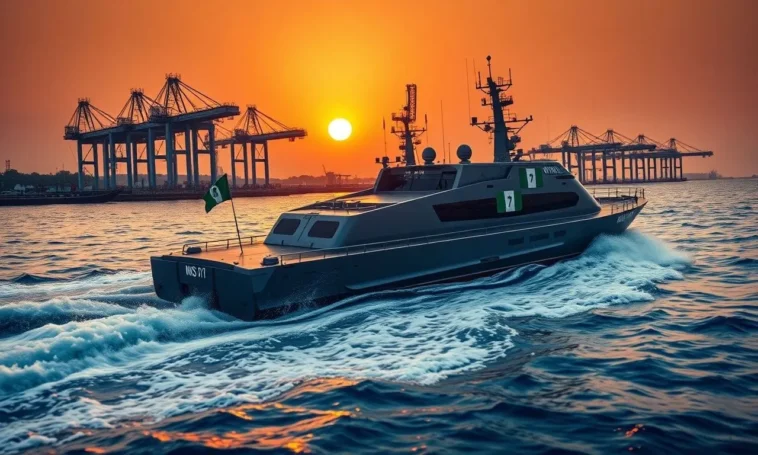
Nigerian Navy Local Warship Production
Charting a New Course: How the Nigerian Navy is Revolutionizing Local Warship Production for 2026
Nigerian Navy local warship production is transforming the nation into a West African maritime powerhouse, reducing reliance on foreign imports through indigenous engineering.By Ryan Chen (@RChenNews)Technology & Defense Correspondent, Naija NewsBurrow
Table of Contents
- Nigerian Navy Local Warship Production
- Charting a New Course: How the Nigerian Navy is Revolutionizing Local Warship Production for 2026
- Beyond the Horizon: Nigeria’s Bold Defiance of Maritime Dependence
- The Doha Declaration: How DIMDEX 2026 Put Nigeria on the Global Map
- A Lineage of Steel: The Evolution from NNS Andoni to the NNS Oji
- The 2030 Vision: Deconstructing the 60% Local Content Mandate
- The Lagos Engine Room: Inside the Naval Dockyard’s High-Tech Transformation
- The Seaward Guardians: Why the SDB Program is Nigeria’s Secret Weapon
- Smart Lethality: Integrating Precision Munitions into Nigerian Hulls
- The Aradu Resurrection: A Masterclass in Modernization and Tech Absorption
- The Blue Ripple: How Shipbuilding is Saving the Naira and Creating Jobs
- Stormy Seas Ahead: Confronting the R&D and Funding Bottlenecks
- The New Regional Powerhouse: Anchoring West African Sovereignty
- Shop Products On Amazon
- Shop Products on Ebay
- Trending Similar Stories in the News
- Trending Videos of Nigerian Navy Local Warship Production
- Similar Popular Articles
Beyond the Horizon: Nigeria’s Bold Defiance of Maritime Dependence
For decades, the rhythmic beating of the Atlantic waves against the Nigerian coastline carried a silent, expensive irony. A nation defined by its vast “Blue Economy” remained tethered to foreign shipyards, spending billions in hard currency to import the very steel meant to protect its sovereignty. But in 2026, that narrative isn’t just changing—it is being systematically dismantled. The Nigerian Navy is no longer just a consumer of global maritime tech; it has become a creator.
The shift is as psychological as it is industrial. By moving from a “buyer” mindset to a “builder” philosophy, the Navy is insulating itself against global supply chain shocks and the predatory pricing of international arms dealers. This isn’t merely about saving money; it’s about tactical autonomy. When you build the hull, you own the secrets of the ship, making the Nigerian fleet a far more unpredictable and formidable opponent in the Gulf of Guinea.
This revolution is anchored in a gritty, hands-on approach to engineering. We are seeing a generation of Nigerian naval engineers who are no longer content with just “maintenance.” They are redesigning the future of African warfare. The shock factor here isn’t just that we are building ships—it’s the speed at which we are integrating complex combat systems into locally fabricated steel, a feat many critics claimed was a decade away.
The Doha Declaration: How DIMDEX 2026 Put Nigeria on the Global Map
At the Doha International Maritime Defence Exhibition (DIMDEX) 2026, held this January, the atmosphere was electric. Vice Admiral Idi Abbas, the Chief of the Naval Staff, didn’t arrive with a shopping list; he arrived with a portfolio. Nigeria’s presence at one of the world’s most prestigious defense gatherings signaled a massive pivot. The message was clear: Nigeria is open for partnership, but only on the terms of technology transfer.
Abbas’s engagement with international maritime giants wasn’t about off-the-shelf purchases. Instead, the Navy pushed for “co-creation” models. This means any foreign firm wanting to do business with Nigeria must now agree to build or assemble significant components on Nigerian soil. This hardline stance on tech-transfer is what will eventually turn the Naval Dockyard in Lagos into a regional powerhouse for the entire West African sub-region.
The ripples of this diplomatic maneuvering are already being felt. Industry insiders suggest that several Middle Eastern and European firms are now scouted for joint-venture shipyards in Nigeria. This is the “shock” to the system—Nigeria is no longer the “big brother” that just pays the bills; it is the “big brother” that is building the factory. The world is watching a shift in the balance of naval power in the South Atlantic.
A Lineage of Steel: The Evolution from NNS Andoni to the NNS Oji
To understand where we are going, we must look at the steel skeletons of the past. The journey didn’t start today; it began with the experimental whispers of the MV Sauka Lafia in 2010. However, it was the NNS Andoni (2012) and the NNS Karaduwa (2016) that proved the Nigerian Navy could produce seaworthy combatants. These weren’t just boats; they were proofs of concept that survived the harsh realities of the sea.
The crowning jewel of this indigenous lineage remains the NNS Oji, commissioned in 2021. The Oji represented a leap in sophistication, featuring improved stability and integrated surveillance systems. It proved that Nigerian engineers could handle the complexity of a Seaward Defence Boat (SDB) without the constant oversight of foreign contractors. Each vessel in this list represents a rung on the ladder toward total naval independence.
| Vessel Name | Year Commissioned | Type/Class | Primary Role |
|---|---|---|---|
| MV Sauka Lafia | 2010 | Patrol Boat | Coastal Surveillance |
| NNS Andoni | 2012 | SDB I | Anti-Poaching/Piracy |
| NNS Karaduwa | 2016 | SDB II | Maritime Interdiction |
| MV Tug Commander Ugwu | 2016 | Tug/Auxiliary | Fleet Support |
| NNS Oji | 2021 | SDB III | Regional Security |
The 2030 Vision: Deconstructing the 60% Local Content Mandate
The Nigerian Navy Strategic Plan 2021–2030 isn’t just a document gathering dust in Abuja; it is a tactical manual. The core objective is breathtakingly ambitious: 60% local shipbuilding capacity by the year 2030. This means that within the next four years, more than half of everything that floats in the Navy’s inventory will have been touched, repaired, or built by Nigerian hands.
This mandate is forcing a radical reorganization of naval logistics. It’s no longer about finding the cheapest foreign supplier; it’s about developing the most reliable local one. This policy is the catalyst for the “industrial military complex” that Nigeria has lacked for sixty years. By guaranteeing a market for local steel and naval components, the Navy is single-handedly propping up an entire sub-sector of the manufacturing industry.
However, the 60% target is also a shield against the “sanctions trap.” We’ve seen other nations crippled because they couldn’t get spare parts for their foreign ships during diplomatic spats. Nigeria is ensuring that no matter the global political climate, our fleet remains operational because the parts are made in Lagos, Port Harcourt, and Delta. It is the ultimate insurance policy for national security.
The Lagos Engine Room: Inside the Naval Dockyard’s High-Tech Transformation
If the Navy is the body, the Naval Dockyard Limited (NDL) in Lagos is the beating heart. Recent working visits by the Naval High Command reveal a facility that looks less like a traditional repair yard and more like a high-tech fabrication center. Massive investments in CNC machines, advanced welding robotics, and 3D modeling software have transformed the yard’s throughput.
But it’s not just Lagos. The Naval Shipyard in Port Harcourt is being primed for specialist vessels. The strategy is to create a “distributed manufacturing” network. While Lagos focuses on the heavy hulls of the Seaward Defence Boats, Port Harcourt is specializing in auxiliary craft and offshore survey vessels. This prevents a single point of failure and spreads the economic benefits of shipbuilding across the Niger Delta.
The “shock” here is the level of private-sector integration. For the first time, we are seeing the Navy invite local tech startups to test “Internet of Things” (IoT) sensors on these hulls. This synergy between the military and the tech ecosystem in Yaba and beyond is creating a “Smart Navy” that is uniquely adapted to the specific challenges of the Gulf of Guinea.
The Seaward Guardians: Why the SDB Program is Nigeria’s Secret Weapon
The Seaward Defence Boat (SDB) program is the flagship of this entire movement. These aren’t just boats; they are the front line against the piracy and oil theft that bleed billions from the Nigerian economy every year. The SDBs are specifically designed for the choppy, unpredictable waters of our coast—shallow enough to pursue criminals into the creeks, but sturdy enough for deep-sea patrols.
Currently, reports indicate that SDBs four and five are nearing completion. These new units are rumored to feature significantly upgraded electronic warfare suites and improved fuel efficiency, allowing them to stay at sea longer without refueling. This “endurance” factor is critical. A Navy that can stay out longer is a Navy that deters crime more effectively without firing a single shot.
Projected Fleet Growth (Indigenous Units):
2010 [##] 1
2016 [####] 3
2021 [#####] 5
2026 [#######] 8 (Projected)
2030 [##########] 15+ (Target)
(ASCII Graph: Visualizing the acceleration of indigenous vessel delivery since 2010.)
Smart Lethality: Integrating Precision Munitions into Nigerian Hulls
A ship is only as good as its teeth. The most significant “twist” in the 2026 strategy is the move toward “Smart Lethality.” Nigeria is no longer satisfied with mounting old-school cannons on its ships. The Navy is currently exploring technology-sharing agreements for precision-guided munitions that can be integrated into the locally built SDB frames.
This creates a hybrid warrior: a hull made of Nigerian steel, carrying a brain optimized for precision strikes. By working with partners in Turkey and the Middle East, the Navy is ensuring that these ships can engage threats from miles away with surgical accuracy. This reduces collateral damage and ensures that the Navy maintains a technological “overmatch” against increasingly well-armed non-state actors.
The integration process is where the real magic happens. It’s one thing to buy a missile; it’s another to write the code that allows your ship’s radar to talk to that missile. Nigerian computer scientists within the Naval Space Command and engineering units are now at the forefront of this systems integration, proving that our “local content” isn’t just about welding—it’s about coding.
The Aradu Resurrection: A Masterclass in Modernization and Tech Absorption
The NNS Aradu, the legendary flagship of the Nigerian Navy, is currently the center of a high-stakes reconstruction project. By signing an MoU with a Turkish shipyard for its remodeling, the Navy isn’t just fixing an old ship; they are conducting a massive masterclass in “reverse engineering.”
Nigerian engineers are embedded in every stage of the Aradu’s transformation. They are learning how a massive frigate is gutted and refitted with 21st-century sensors and engines. This knowledge is then brought back to our local dockyards. The Aradu project is essentially a “university on water” for the next generation of Nigerian naval architects.
The audacity of this move cannot be overstated. Instead of scrapping the Aradu and buying a new foreign vessel, Nigeria is choosing to reclaim its history while training its future. When the Aradu returns to the waves, it won’t just be a refurbished ship; it will be a testament to Nigeria’s refusal to let its maritime legacy sink into obsolescence.
The Blue Ripple: How Shipbuilding is Saving the Naira and Creating Jobs
The economic argument for local warship production is undeniable. Every ton of steel fabricated in Lagos is money that stays within the Nigerian economy. We are seeing the birth of a “Blue Ripple” effect. For every one naval engineer hired, there are ten downstream jobs created—from the welders and electricians to the logistics providers and technical college instructors.
This is industrialization by design. By fostering a domestic maritime industry, the Navy is helping to stabilize the Naira. Instead of exporting dollars to pay foreign shipbuilders, we are investing those funds into Nigerian businesses. This is the “patriotic economy” in action, turning defense spending into a national investment with actual returns for the taxpayer.
Moreover, the skills being developed are highly transferable. A welder certified to work on a naval warship is a welder who can work on oil rigs, merchant ships, and infrastructure projects. The Nigerian Navy is essentially running a national vocational training program that is upgrading the entire country’s technical workforce capacity.
Stormy Seas Ahead: Confronting the R&D and Funding Bottlenecks
However, let us not be blinded by the glare of new steel. The path to 60% capacity is fraught with challenges. Historical under-investment in Research and Development (R&D) remains a significant anchor. While we are great at fabrication, we are still catching up in the areas of high-end proprietary sensor design and engine manufacturing.
The “shock” to the public should be this: if funding isn’t consistent, these shipyards could become expensive graveyards. We need long-term industrial policy support that transcends political administrations. The current momentum is strong, but it requires a sustained appetite for risk and a willingness to fund “failures” in the R&D lab before they become “successes” on the ocean.
There is also the challenge of the “ecosystem.” A shipyard is only as good as the steel mills and technical colleges that support it. Nigeria must revitalize its domestic steel industry—specifically Ajaokuta—to provide the raw materials for these ships. Without local steel, “local production” still leaves us vulnerable to foreign commodity prices.
The New Regional Powerhouse: Anchoring West African Sovereignty
As we look toward the end of 2026, the Nigerian Navy is no longer just a national force; it is becoming a regional provider of security. By building our own ships, we are proving to our neighbors in the Gulf of Guinea that African solutions to African problems are not only possible—they are superior.
The potential for Nigeria to become a “Warship Hub” for West Africa is real. Imagine a future where Ghana, Togo, and Benin commission patrol boats from Nigerian dockyards. This would not only boost our exports but also create a unified maritime defense architecture where all regional ships share the same “DNA,” making joint operations seamless.
The revolution is here. It is loud, it is heavy, and it smells of molten steel. The Nigerian Navy has charted a new course, and there is no turning back. We invite you, our readers, to join this conversation. Is Nigeria ready to lead Africa’s naval industrialization? What more can be done to support our local engineers? The waves of the future are waiting, and for the first time in a long time, Nigeria is the one building the ships to ride them.
Join the conversation on social media! What do you think about Nigeria building its own warships? Tag us @NewsBurrowNigeria and let your voice be heard!
As the Nigerian Navy accelerates its push toward 2026 with indigenous warships like the NNS Oji, the spotlight is shifting toward the sophisticated internal systems that make these vessels true masters of the Atlantic. Building a hull is a feat of engineering, but equipping it with world-class maritime intelligence is what ensures our officers can navigate treacherous corridors and intercept threats with pinpoint accuracy. For maritime enthusiasts, shipowners, and tech followers, understanding the precision tools behind these local successes is the next step in appreciating Nigeria’s naval evolution.
The transition to a self-reliant maritime force has sparked a surge in demand for high-performance hardware that mirrors the standards seen at DIMDEX 2026. Whether you are managing a private fleet or simply fascinated by the tactical gear that powers modern seafaring, having access to the right equipment is essential for safety and dominance on the open water. We have curated a selection of top-tier maritime solutions that align with the high standards of our developing naval industry, offering you a chance to bring professional-grade precision to your own maritime ventures.
Don’t miss out on the technology that is currently redefining how we monitor and protect our vast sovereign waters. Explore these essential maritime tools today and see how you can upgrade your operational awareness to match the cutting-edge standards of the Nigerian Navy. Join the conversation in the comments below with your thoughts on our local shipbuilding milestones, and be sure to subscribe to the Naija NewsBurrow newsletter for exclusive updates on Nigeria’s rising military industrial complex.
Shop Products On Amazon
Shop Products on Ebay




Trending Similar Stories in the News
Navy steps up efforts to boost local warship production Punch Newspapers...
Naval Chief Aɓbas Seeks Technology Transfer To Boost Nigerian Navy’s Indigenous Shipbuilding Capacity Arise News...
Trending Videos of Nigerian Navy Local Warship Production
Nigerian Navy - Best Navy In Africa #military #marine #nigeria #navy #sailors
Similar Popular Articles
#NigerianNavy #Shipbuilding #DefenseTech #NigeriaNews #Maritime
Nigerian Navy News, Local Shipbuilding Nigeria, Maritime Security 2026, Defense Technology Africa
