
 Emily Carter
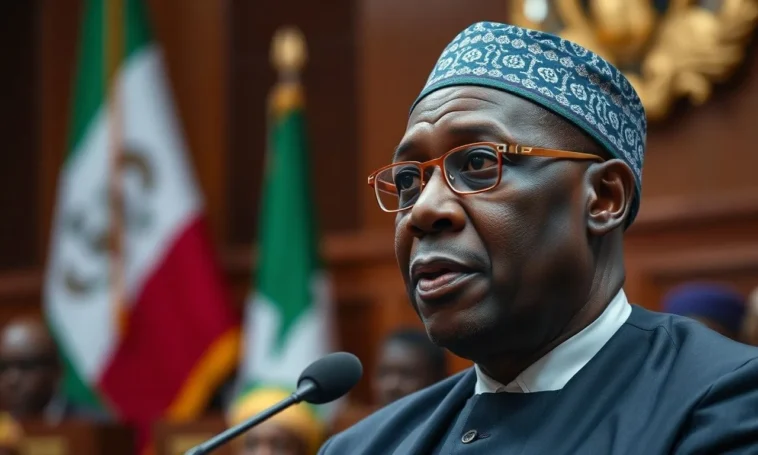
Tinubu State Police Constitutional Amendment
Tinubu Moves for State Police: President Urges Senate to Fast-Track Constitutional Amendment
Tinubu State Police constitutional amendment proposals have taken center stage as the President formally tasks the Senate to overhaul Nigeria’s security framework for better grassroots protection.The Great Decentralization: Tinubu’s Bold Gambit for State-Led Policing
In a move that has sent shockwaves through Nigeria’s political corridors, President Bola Ahmed Tinubu has finally drawn a line in the shifting sands of national security. During a high-stakes interfaith dialogue with the leadership of the 10th Senate, the President didn’t just suggest reform; he demanded it. The message was clear: the era of “policing from Abuja” is failing, and the time for a Tinubu State Police constitutional amendment is now.
Table of Contents
- Tinubu State Police Constitutional Amendment
- Tinubu Moves for State Police: President Urges Senate to Fast-Track Constitutional Amendment
- The Great Decentralization: Tinubu’s Bold Gambit for State-Led Policing
- Beyond the Abuja Command: Why the Center Can No Longer Hold
- Legislative Fireworks: The High Hurdles of Constitutional Change
- The Disu Doctrine: Modernizing the Force from the Top Down
- A Nation Divided? Tracking Regional Sentiments Across the Zones
- The “State Militia” Fear: Building Failsafes Against Political Abuse
- The Bottom Line: Who Pays the Bill for Local Security?
- The Turning Point: A Final Verdict on the State Police Crusade
- Shop Products On Amazon
- Shop Products on Ebay
- Trending Similar Stories in the News
- Trending Videos of Tinubu State Police Constitutional Amendment
- Similar Popular Articles
The President’s appeal marks a definitive pivot in the “Renewed Hope” agenda, transitioning from mere policy talk to an urgent legislative directive. For decades, the debate over state policing has been a political football, kicked around by successive administrations wary of losing central control. But as 2026 unfolds, the sheer scale of banditry and regional insurgency has forced the hand of the Commander-in-Chief.
This is not just about adding more boots on the ground; it is a fundamental reimagining of the Nigerian state. By urging the Senate to fast-track these amendments, Tinubu is signaling that the federal government can no longer bear the solitary burden of securing 200 million lives. The air in the capital is thick with anticipation—and a healthy dose of skepticism—as the nation prepares for its most significant legal overhaul since the return to democracy.
Our reporters at Naija NewsBurrow have gathered that this legislative push is being treated as a “national emergency” bill. The presidency is reportedly looking at a 12-month window to see the first batch of state-trained officers hit the streets. It is a race against time, where the prize is nothing less than the survival of the federation’s domestic peace.
Beyond the Abuja Command: Why the Center Can No Longer Hold
The current Nigerian security architecture restructuring 2026 is born out of a grim reality: the Nigeria Police Force (NPF) is overstretched, underfunded, and fundamentally detached from the communities it serves. A police officer from Maiduguri serving in the creeks of the Delta lacks the linguistic and cultural intelligence required for effective crime prevention. Tinubu’s argument rests on the fact that local intelligence is the only true antidote to localized terror.
Critics have long argued that Nigeria is too fragile for decentralized arms, but the Presidency is countering this with a “complementary layers” theory. State police would not replace the federal force but would act as a specialized local shield. This shield is intended to provide rapid response capabilities that the current centralized bureaucracy simply cannot match in the heat of a crisis.
Furthermore, the economic cost of insecurity has reached a breaking point. From abandoned farms in the Middle Belt to the disrupted supply chains in the Northwest, the “security tax” on the Nigerian economy is staggering. By empowering states to protect their own economic hubs, Tinubu hopes to unlock subnational productivity that has been suppressed by the constant fear of kidnapping and arson.
This section of the reform is particularly punchy: it challenges the long-held Nigerian myth that “unity” requires “uniformity.” Tinubu is betting that a more fragmented security structure will actually lead to a more unified and stable nation. It is a counter-intuitive gamble that has both his allies and his detractors holding their breath.
Legislative Fireworks: The High Hurdles of Constitutional Change
Amending the 1999 Constitution is notoriously like trying to turn an oil tanker in a bathtub—slow, difficult, and prone to resistance. To achieve constitutional amendment for state police, the Senate must navigate a minefield of vested interests. This involves moving policing from the “Exclusive List” (controlled solely by the Federal Government) to the “Concurrent List,” allowing states to share the legislative burden.
The process requires a two-thirds majority in both the Senate and the House of Representatives, followed by approval from at least 24 of the 36 State Houses of Assembly. It is a political marathon that requires immense executive lobbying. Below is a simplified breakdown of the projected legislative milestones for this reform:
| Phase | Key Action | Expected Timeline | Potential Obstacle |
|---|---|---|---|
| I: Drafting | Executive Bill submission to NASS | Q1 2026 | Jurisdictional disputes |
| II: Deliberation | Public hearings and Committee reviews | Q2 2026 | Opposition from minority blocs |
| III: State Approval | Voting in 36 State Assemblies | Q3-Q4 2026 | Funding concerns by Governors |
| IV: Enactment | Presidential Assent and Pilot Launch | Q1 2027 | Implementation logistics |
The “shock factor” here is the potential for a legislative stalemate. If even a handful of powerful northern or southern governors feel that the funding model is unfair, they could kill the bill in the state assemblies. Tinubu is essentially asking governors to put their money where their mouths are, and not all of them are ready for the financial weight of a standing army.
The Disu Doctrine: Modernizing the Force from the Top Down
While the legislative battle rages, the operational shift is already beginning. The appointment of Acting IGP Olatunji Disu is seen by many as the “bridge” between the old guard and the new era of President Tinubu state police reform Nigeria. Disu, known for his tech-savvy approach and focus on intelligence-led policing, is reportedly drafting the “Standard Operating Procedures” (SOPs) that state forces will eventually have to follow.
This modernization effort aims to clean up the image of the Nigerian Police before the decentralization begins. There is a deep-seated fear among the public that state police will simply be “thugs in uniforms” used by governors to suppress the opposition. Disu’s task is to create a national certification board that ensures a constable in Lagos meets the same human rights standards as one in Kano.
The Presidency is also looking at significant investments in “Digital Policing.” We are talking about drone surveillance, centralized biometric databases, and real-time inter-agency communication. The goal is a “Smart Shield” where the state police handle the street-level patrols, while the federal police focus on interstate crimes and national counter-terrorism.
However, the retirement of several Deputy Inspectors-General following Disu’s climb has raised eyebrows. It suggests a “clean sweep” of the old hierarchy to make way for a more compliant, reform-minded leadership. Whether this leads to efficiency or a loss of institutional memory remains a heated topic of debate within the security circles.
A Nation Divided? Tracking Regional Sentiments Across the Zones
The benefits of state policing in Nigeria are viewed differently depending on where you stand on the map. In the Southwest, the success of the Amotekun corps has created a hunger for full police powers. In the Southeast, there is a mix of desire for protection against herder-farmer clashes and a fear that state police might be used to further complicate the regional agitation movements.
The North presents the most complex reaction. While some governors in the Northwest are desperate for local forces to flush out bandits from the forests, others worry about the financial sustainability of such a move. They fear that a “rich state” like Lagos will have a world-class force, while a “poor state” will be left defenseless, creating a security vacuum that criminals will exploit.
To visualize the current regional support for the amendment, consider the following approximation of sentiment levels across the six geopolitical zones:
REGIONAL SUPPORT FOR STATE POLICE (2026 ESTIMATE)Southwest:  [########################] 95%
Southeast:  [##################------] 70%
South South:[################--------] 65%
North Cent: [###################-----] 75%
North West: [############------------] 50%
North East: [#########---------------] 35%(Scale: # = Support, - = Skepticism/Opposition)
This disparity highlights the President’s biggest challenge: selling a “one-size-fits-all” constitutional change to a nation with six different security realities. The North East, still reeling from the remnants of Boko Haram, remains the most skeptical, preferring the heavy-duty protection of the Nigerian Army over a localized police force.
The “State Militia” Fear: Building Failsafes Against Political Abuse
The most chilling argument against Tinubu urges Senate on state police is the potential for tyranny. Nigeria has a long history of politicians using security apparatuses as private hit squads. If a Governor controls the police, the payroll, and the promotion list, what stops them from arresting political rivals on the eve of an election? This is the “shock factor” that keeps civil rights activists awake at night.
To counter this, the proposed amendment reportedly includes “The Golden Failsafes.” These are a set of constitutional triggers that allow the Federal Government to “re-centralize” a state’s police force if there is proven evidence of partisan abuse or human rights violations. It is a “break-glass-in-case-of-emergency” clause that seeks to balance autonomy with national integrity.
Furthermore, the funding model is being designed to be independent of a Governor’s whims. Suggestions include a “Police Trust Fund” at the state level, managed by a board of trustees comprising traditional rulers, civil society, and professional bodies. This would ensure that even if a Governor is displeased with the police, he cannot “starve” them into submission by withholding salaries.
But can these laws truly restrain the “strongmen” of Nigerian politics? History suggests that laws are only as good as the people who enforce them. The 10th Senate’s greatest task will not be passing the bill, but writing the accountability clauses in permanent ink that cannot be erased by an ambitious politician.
The Bottom Line: Who Pays the Bill for Local Security?
We must talk about the “Naira in the room.” State policing is an expensive venture. Beyond recruitment and training, there is the matter of weaponry, forensics labs, armored vehicles, and pensions. In a year where the national budget is already under pressure from debt servicing, where will the money come from?
Some proponents suggest a revision of the Revenue Allocation Formula. Currently, the Federal Government takes the lion’s share of the federation account. If states are to take over security—the most expensive function of government—they will naturally demand a larger slice of the pie. This could lead to a secondary constitutional battle over resource control.
The fiscal implications are summarized in the potential budget allocation shifts below:
| Expenditure Item | Est. Cost Per State (Annual) | Source of Funding |
|---|---|---|
| Personnel Salaries | N15 Billion – N40 Billion | State IGR + Fed Allocation |
| Equipment & Tech | N10 Billion | Security Trust Fund |
| Training Facilities | N5 Billion | Federal Intervention Grant |
| Intelligence/Forensics | N8 Billion | Public-Private Partnership |
This financial burden is why the “2026 Restructuring” is so contentious. It forces a conversation about the very nature of Nigerian federalism. Are we a collection of sovereign states or a centralized entity with provincial administrative units? Tinubu’s move for state police is the final push toward the former.
The Turning Point: A Final Verdict on the State Police Crusade
President Bola Tinubu’s call to the Senate is more than a policy shift; it is a confession that the old ways have died. The “Center” can no longer hold the line against the hydra-headed monster of modern insecurity. By championing the Tinubu State Police constitutional amendment, the President is attempting to decentralize risk and localize resilience.
However, the road ahead is fraught with political landmines. Between the legislative hurdles in the National Assembly and the regional suspicions across the 36 states, this reform could either be Tinubu’s greatest legacy or his most spectacular failure. The stakes could not be higher. If successful, Nigeria becomes a truly federal republic; if it fails, the security vacuum may grow large enough to swallow the “Renewed Hope” entirely.
At NewsBurrow Nigeria, we believe this is the conversation that will define the next decade of our democracy. Will state police bring the peace we crave, or will it simply create 36 new problems? The Senate now holds the pen, and the nation is waiting to see what they write.
What do you think? Is your state ready to manage its own police force, or do you fear the potential for abuse? Join the conversation on our social media handles and let your voice be heard. The future of your security is on the ballot.
By Emily Carter (@ECarterUpdates) — Political Analyst for NewsBurrow Nigeria.
As the federal government pivots toward a decentralized security model, the conversation across Nigerian households is shifting from policy to practical protection. While the legislative wheels turn in Abuja to establish state-level policing, many citizens are recognizing that the first line of defense begins at their own front door. The push for constitutional reform underscores a critical reality: security is most effective when it is localized, responsive, and immediate.
For the proactive homeowner, waiting for high-level structural changes is only part of the solution in today’s evolving landscape. In an era where “smart” technology is bridging the gap left by traditional surveillance, the demand for advanced residential protection has surged by over 15% this year alone. Integrating high-tech monitoring with the upcoming regional security initiatives ensures that your family remains insulated from the uncertainties of a changing national architecture.
Stay ahead of the curve by securing your immediate environment today while the nation prepares for a safer tomorrow. We invite you to join the conversation in our comments section below—how do you plan to enhance your home’s safety in 2026? Don’t forget to subscribe to the Naija NewsBurrow newsletter for exclusive updates on security trends and legislative breakthroughs. Explore our curated selection of top-tier protective solutions to find the perfect fit for your household needs.
Shop Products On Amazon
Shop Products on Ebay







Trending Similar Stories in the News
Tinubu Urges Senate To Amend Constitution For State Police Arise News...
Tinubu asks senators to amend constitution for state police Peoples Gazette Nigeria...
Trending Videos of Tinubu State Police Constitutional Amendment
Tinubu asks APC governors to back state police, local government autonomy
Similar Popular Articles
#NigeriaPolitics #StatePolice #Tinubu #SecurityReform #NaijaNews
Tinubu State Police, Constitutional Amendment Nigeria, Nigeria Security News, State Policing Law, 10th National Assembly



GIPHY App Key not set. Please check settings